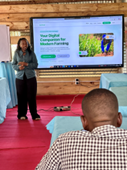
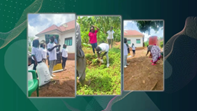
Food Harmony is a Saint Lucian agribusiness dedicated to regenerative agriculture, healthy food production, and food systems education.

Food Harmony
read more

Ecobed Biotech Brand transforms organic waste into valuable resources, empowering smallholder farmers, promoting climate resilience, and developing eco-friendly products like mosquito repellent skincare lotions.

ABOUT ECOBED BIOTECH BRAND
Jovia Kisaakye, Founder & CEO
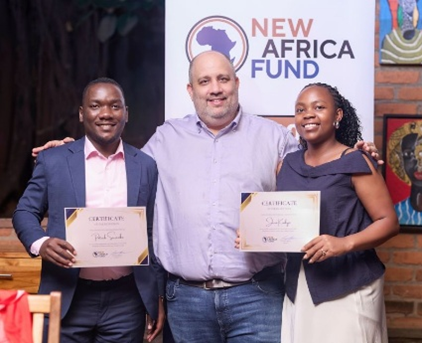
Jovia Kisaakye is a Ugandan social entrepreneur and the Founder & CEO of Ecobed Biotech Brand, a climate-smart enterprise transforming food waste into mosquito repellent lotion, organic fertilizers, and animal feeds. With a background in Business Statistics, Jovia combines data-driven insights with grassroots innovation to tackle malaria, food insecurity, and environmental degradation. Her work empowers women and smallholder farmers through circular economy models. Jovia is an alumnus of YALI EA, Vital Voices, and Watson Institute, and has been recognized by UNCTAD for her role in circular economy and awarded the Empretec Women in business award.
She has also received several support and funding from organizations such as RUFORUM, NSSF Uganda, The Mastercard foundation, Tony Elumelu Foundation, The AGRA, Moonshot Inc, Dovetail Impact foundation among others to develop and scale impact-driven solutions across East Africa. A former Youth and Women Representative under the African Union Youth Reference Committee and a climate advocate, Jovia emerges as a thought leader in circular bioeconomy systems, climate resilience, and inclusive food markets across East Africa.
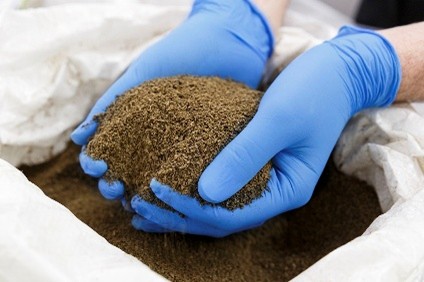
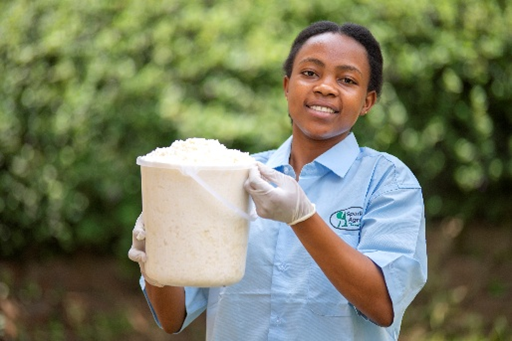
Through Ecobed Biotech, she has developed solutions such as converting food waste into organic fertilizers and animal feed, as well as transforming spoiled milk into mosquito repellent and skincare lotion. Alongside product innovation, she is expanding into digital solutions to improve food recovery and market access.
BUSINESS MODEL
Ecobed Biotech was founded to address the growing challenge of food waste and its impact on farmers, markets, and communities. The idea originated from observing how large quantities of food and agricultural by-products were being discarded despite their potential value. At the back of her home, the founder witnessed her parents discarding hundreds of litres of milk everyday due to poor storage in limited markets. To curb this, she dedicated herself to find wasy to prolong milk value or find value in the wasted milk which later prompted her to convert spoilt milk into lotions and creams. The business progressively evolved to tackle broader challenges within the agricultural ecosystem. Through continuous learning and exposure, Jovia expanded the model to include black soldier fly technology, enabling the conversion of organic waste into animal feed and fertilizers.
Over time, Ecobed Biotech has grown from a small idea into a diversified solution addressing waste management, input production, and market inefficiencies. The company has also introduced a mobile application to facilitate the collection and redistribution of surplus food, helping reduce losses and connect vendors and farmers to new market opportunities.
Ecobed Biotech operates as a circular agribusiness model, combining waste recovery, processing, and digital solutions.
Mission: To transform food and agricultural waste into valuable products that support farmers, reduce losses, and create sustainable livelihoods.
Vision
To build an innovative and inclusive ecosystem where waste is minimised, resources are efficiently used, and farmers have improved access to inputs and markets.
Core activities
Key differentiators
STRONG RELATIONSHIPS WITH SMALLHOLDERS, COOPERATIVES…
Ecobed Biotech operates as an integrated, multi-sided platform connecting smallholder farmers, cooperatives, food vendors, supermarkets and end buyers through a digitally enabled marketplace. The company’s relationship with farmers is both commercial and developmental. It supports them through market access, input linkages, equipment rental and training in climate-smart agricultural practices. Ecobed Biotech also collaborates with aggregators, distributors, restaurants, retailers and other food businesses to improve supply efficiency and support the redistribution of produce and surplus food.
To date, Ecobed Biotech works with more than 170,560 farmers, approximately 60% of whom are women. The average age of participating farmers ranges from 25 to 45 years, reflecting a strong youth presence. Most farmers operate smallholder plots of around 1 to 3 acres, mainly under mixed farming systems.
The company’s network also includes partnerships with local processors, packaging providers and logistics actors. These partnerships help streamline value chains, reduce post-harvest losses, improve product quality and strengthen delivery efficiency.
Ecobed Biotech operates at the intersection of agriculture, waste management and local markets in Uganda. Its model addresses several key challenges, including high levels of food waste in urban markets, limited access to affordable agricultural inputs and weak market linkages for small-scale farmers.
By working with market vendors, food suppliers, farmers, processors and logistics actors, Ecobed Biotech positions itself as a value chain solution provider rather than a company focused on a single product segment.
PRODUCTS AND MARKETS
Ecobed Biotech offers a range of circular solutions that transform food waste into useful products, while also using digital tools to connect farmers, vendors and buyers more efficiently.
Product range :
Distribution channels :
INNOVATIONS: MILESTONES AND EXPANSION PLANS
Ecobed Biotech’s innovation lies in its ability to combine simple, locally available resources with practical technologies.
Key innovations and milestones :
Expansion plans
SUCCESS FACTORS AND LESSONS LEARNED
The growth of Ecobed Biotech has been shaped by a combination of resilience, market responsiveness and strategic networking. Despite early funding challenges, Jovia continued to develop and refine the company’s solutions, using customer feedback and market research to better understand real needs and adapt the business model accordingly.
Several factors have contributed to the company’s progress, including its ability to remain flexible, test new ideas, and expand its solutions beyond a single product. Visibility through events, networks and partnerships has also played an important role in opening new opportunities and strengthening the company’s positioning.
At the same time, the journey has highlighted key challenges faced by many early-stage agribusinesses. Access to finance remains difficult, and small grants have been important in supporting initial growth. Market validation has also been essential, as products need to be continuously tested, improved and aligned with customer expectations. In addition, introducing new circular and sustainable solutions requires awareness raising, education and behaviour change among users and partners.
Overall, Jovia’s experience highlights that building a successful agribusiness requires more than innovation. It also depends on consistent engagement with the market, strong documentation of progress and impact, and the ability to build strategic relationships over time.
Additional Resources
Recent Business Profiles
Food Harmony is a Saint Lucian agribusiness dedicated to regenerative agriculture, healthy food production, and food systems education.

Enimiro Products Uganda Ltd develops traceable and sustainable agricultural value chains in vanilla, coffee and dried fruits, empowering smallholder farmers, strengthening rural livelihoods and...
The Plant Doctor is an agribusiness focused on the development and production of organic agricultural inputs and plant health solutions.

Rhea is a Kenyan AgriTech company providing AI-powered soil testing and soil health solutions to help smallholder farmers improve yields and farm sustainably.
Akata Farms is a Grenada-based agribusiness producing sustainable, high-quality food while integrating digital innovation and supporting local farmers and markets.